FSS
News
Newsletter – October 2026
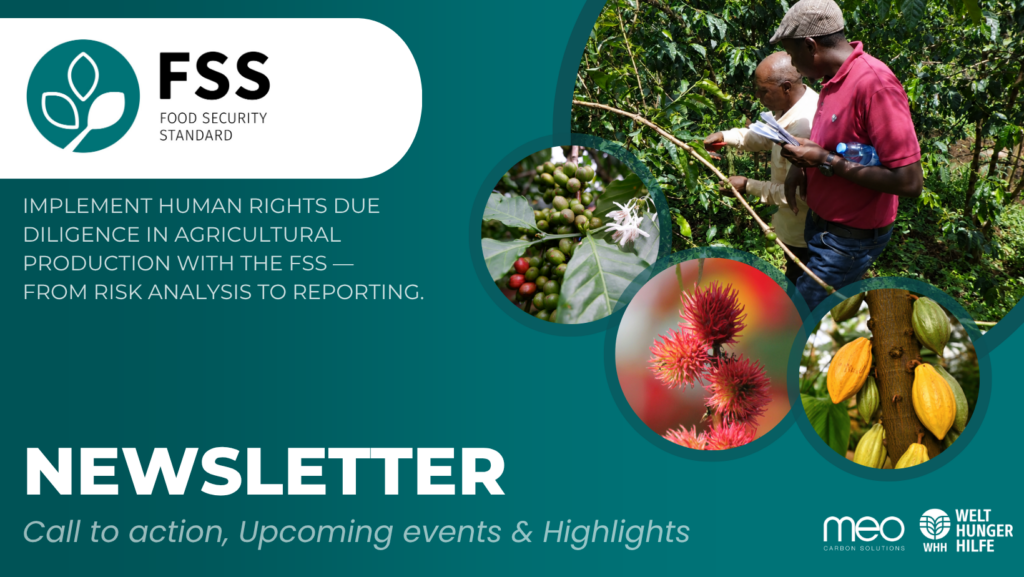
Dear Supporters of the FSS, Human rights due diligence needs to go beyond compliance by addressing food insecurity in agricultural supply chains. In this edition, read about how food security can be put into practice – from our Interactive Farm to why making food security a reality in Kenyan coffee value chains matters. We also … Read more
Making Food Security a Reality in Coffee Value Chains
Kenya is one of the world’s most respected coffee origins — yet behind its specialty Arabica reputation lies a risk that threatens supply chain stability: food insecurity among the farmers who grow it. According to the 2025 Global Hunger Index, 36.8% of Kenya’s population are undernourished, the highest level in 25 years. Over 70% of the rural population depend on agriculture (Central Bank of Kenya, 2024), but only 11.4% of Kenya’s land is arable, and the farming population is ageing — over half of Kenyan coffee farmers are 60 or older, with younger generations increasingly leaving for more stable income (Kenya Coffee Platform). If that trend continues, the future of Kenya’s coffee sector becomes genuinely uncertain.
Explore the Interactive Farm: See the Food Security Standard in Action
Discover the Interactive Farm, a new online tool that brings the Food Security Standard (FSS) to life through real-world implementation examples. Based on the experience of a Colombian palm oil producer, it demonstrates how practical food security measures can strengthen the Right to Adequate Food and support more resilient agricultural supply chains.

Finding Credible Sustainability Standards: The Food Security Standard Now Featured in Three Key Guidance Platforms
As the number of voluntary sustainability standards continues to grow, choosing the right one can be challenging. The inclusion of the Food Security Standard (FSS) in the Standards Compass of the Helpdesk on Business & Human Rights and the FNR Gütezeichen-Finder helps companies identify food security as an essential component of human rights due diligence and responsible sourcing.

Enhancing Food Security in Coffee Production
Coffee is one of the most valuable agricultural commodities in the world, yet many farmers who grow it struggle with food insecurity. This challenge is not unique to coffee but affects workers and smallholders of other agricultural sectors in hunger-affected countries as well, as pointed out by the Global Hunger Index.

A FOSSEM Journey: Vegbox Horticulture Works Towards Fulfilling Human Rights Due Diligence in its Ethiopian Agri-Supply Chain
The Food Security Sensitive Management (FOSSEM) system offers a customizable, step-by-step approach to implement human rights due diligence and realize the right to food, ultimately leading to full FSS certification. This approach is particularly beneficial for farms operating in challenging conditions, as it allows for gradual improvement towards full compliance with certification requirements and food security guarantees.