How the Food Security Standard helps buyers close the EUDR compliance gap
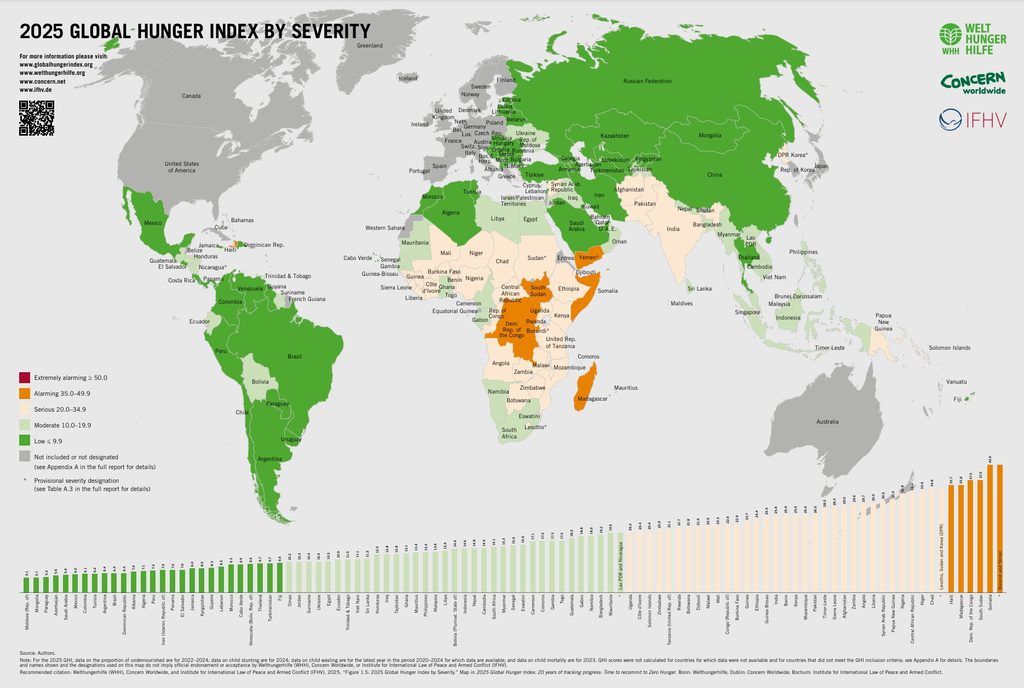
Kenya is one of the world’s most respected coffee origins — yet behind its specialty Arabica reputation lies a risk that threatens supply chain stability: food insecurity among the farmers who grow it. According to the 2025 Global Hunger Index, 36.8% of Kenya’s population are undernourished, the highest level in 25 years. Over 70% of the rural population depend on agriculture (Central Bank of Kenya, 2024), but only 11.4% of Kenya’s land is arable, and the farming population is ageing — over half of Kenyan coffee farmers are 60 or older, with younger generations increasingly leaving for more stable income (Kenya Coffee Platform). If that trend continues, the future of Kenya’s coffee sector becomes genuinely uncertain.
The connection is direct: when global prices fall below production cost — as they did in 2018/19 — farmers lose more than income. They lose the ability to buy food, invest in their trees, or plan ahead. Food insecurity is not a separate issue from the supply chain. It is the supply chain’s most fundamental risk, and a signal for broader human rights vulnerabilities: where farmers cannot feed themselves reliably, land tenure is often insecure, wages are often inadequate, and community voice is often absent.
Why this matters for buyers: EUDR, legality, and the social blind spot
The EU Deforestation Regulation (EUDR) requires that commodities including coffee be produced legally — covering not just deforestation, but also labour rights, human rights, land rights, and the principle of Free, Prior and Informed Consent. Satellite imagery confirms deforestation status. Document reviews assess legal compliance on paper. But neither can tell a buyer whether farmers have secure land tenure, are paid a living wage, or face hunger. In most sourcing regions, there are no centralised records of land use rights. And national-level EUDR country risk classifications obscure local realities — farm-level vulnerabilities are invisible in aggregate data.
This is the gap that on-site verification closes — and that the Food Security Standard (FSS) is specifically designed to address.
How to address food insecurity at farm level
Developed by Welthungerhilfe, WWF and the Center for Development Research at the University of Bonn, now managed by Welthungerhilfe and Meo Carbon Solutions, the FSS is the only standard that directly addresses the human right to food at production level, as an add-on to existing certification systems like Rainforest Alliance. Through on-site audits, document review, and direct one-on-one interviews with farmers, workers and external stakeholders, it generates verified, farm-level evidence of risks that no remote monitoring tool can reveal.
In 2025, two cooperatives in the Coffee Management Services (CMS) network in Kenya received full FSS certification, together covering close to 8 million kilograms of coffee cherries. At farm level, the FSS assessment highlighted the importance of sufficient and reliable household income — not only to maintain a decent standard of living and a healthy diet, but also to sustain investment in coffee production. During difficult seasons, smallholder farmers face a painful trade-off: purchasing adequate food for their households, or meeting the costs required to maintain their farms.
When coffee income is low — due to poor yields, adverse weather, or falling prices — a farmer may have little or no savings after covering essential household expenses. The result is that immediate food needs take priority over purchasing farm inputs, maintaining coffee trees, or investing in productivity. Over time, this creates a cycle of vulnerability: reduced investment leads to lower yields, which leads to lower income, which leaves even less room to invest.
The assessment identified food security risks at farm level and structured practical responses — from livelihood diversification to kitchen gardening — through existing cooperative structures and farmer engagement programmes. For buyers, this is both a sustainability credential and a compliance asset: verified, reportable, farm-level evidence of the social conditions EUDR now requires companies to demonstrate.
“The Food Security Standard has helped us look beyond coffee production and consider the overall wellbeing of our farmers. A productive coffee farmer must also have access to adequate and nutritious food, a stable livelihood and the ability to support their family throughout the year.”
— Chairman, New Ngariama Farmers Cooperative Society
The bottom line
A supply chain that leaves its farmers food insecure is one that is undermining its own future. Farmers who cannot generate sufficient income stop investing in their trees. The younger generation leaves. Quality declines, volumes become unpredictable, and the specialty positioning that justifies premium prices begins to erode.
Addressing food security at farm level is not a charitable add-on. It is essential for long-term supply chain viability — and increasingly, it is what regulators will ask buyers to prove.
Written by Catherine Nganga and Theresa Heering for the Food Security Standard.